
Responsible Gaming
Real-money gambling can lead to financial loss and harm to health, relationships or daily responsibilities. It should not be treated as employment, an investment or a way to recover money already lost.
This page provides general harm-prevention information. It does not confirm that any gaming service is lawful or that a particular operator provides protective tools.
Check Whether Participation Is Permitted
Do not take part in an activity that is prohibited where you live. A working website, accepted payment or age checkbox is not proof of permission.
Gambling-related content on jiolottery-game.com is intended for adults. Children should not be helped to create accounts or use age-restricted services.
Protect Essential Money
Where participation is legally permitted, never use money needed for food, housing, bills, education, healthcare or debt payments.
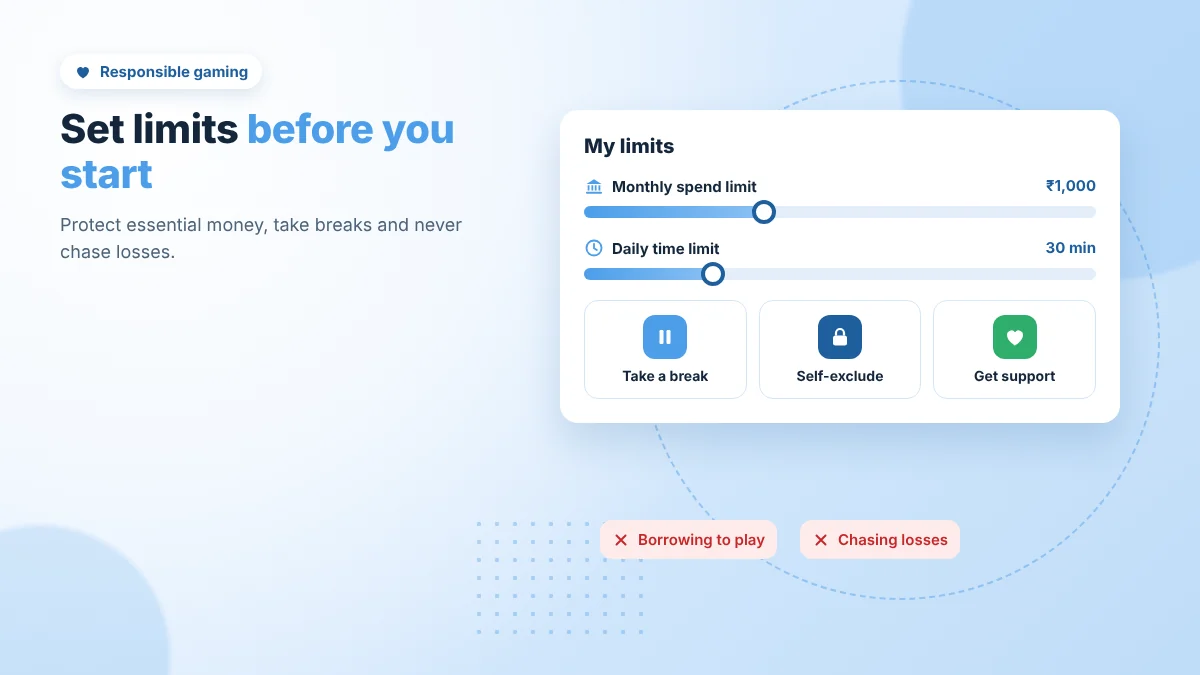
Do not borrow to gamble or use credit to chase a loss. A potential reward does not make the original money safe.
Set a spending and time limit before starting. If you repeatedly exceed it, stop and seek support rather than increasing the limit to match your activity.
Do Not Chase Losses
A loss does not create an obligation to continue. Increasing stakes, making another deposit or switching games can increase the amount at risk.
Claims about guaranteed predictions, winning signals or recovery systems should not be relied on. A previous result is not evidence that a particular next result is due.
Signs That It Is Time to Stop
Pay attention if you:
- Spend more time or money than intended.
- Borrow, sell essentials or miss bills because of gambling.
- Hide transactions or lie about your activity.
- Lose sleep or neglect work, study or relationships.
- Feel driven to return after losing.
- Find it difficult to stop despite wanting to.
You do not need to wait for a severe financial problem before taking action.
Practical Steps to Reduce Access
Stop adding funds and take a break from gambling-related accounts and messages. Remove saved payment details where possible and turn off promotional notifications.
Ask an operator about account closure or self-exclusion if these options exist. Ask your bank or payment provider whether gambling-payment controls are available. Availability and coverage vary.
Blocking tools can help reduce access, but they do not replace support. Do not move to another account to get around a restriction you set for yourself.
Get Support
Speak with someone you trust and consider contacting a qualified mental-health professional, a local gambling-harm service or a debt adviser.
If you feel unable to stay safe or face an immediate emergency, contact local emergency services. This website does not provide crisis counselling or emergency assistance.
Protect Children and Shared Devices
Keep gambling accounts, payment tools and credentials away from children. Use device restrictions where appropriate and avoid leaving signed-in accounts on shared devices.
Do not present gambling as a solution to money problems or encourage another person to participate to earn a referral reward.
Pending Payments Are Not a Reason to Keep Playing
An unresolved deposit or withdrawal should be investigated through its records and verified complaint channels. More play or another deposit does not establish that the payment will be resolved.
Keep the evidence and seek help with the dispute separately from any decision about future participation.