
Jio Lottery Deposit: Payment Checks and Missing Funds
If a Jio Lottery deposit has left your bank account but has not appeared in your gaming balance, check the original transaction before sending more money. Keep the payment reference and compare the status in your payment app with the record shown by the website.
For a new deposit, first establish who operates the service and whether its activity is permitted where you live. Several websites use the Jio Lottery name. A familiar logo or working payment page does not prove that the recipient belongs to your account provider.
This guide explains payment checks, deposit records and common problems. It does not confirm payment methods, fees, limits or processing times for a particular operator.
Before Making a Deposit
Sign in through the website or app associated with your existing account. Check your account ID before opening any payment instructions.
Before a Jio Lottery deposit, check whether the Jio Lottery game you plan to use is permitted where you live and whether the website’s operator can be identified.
Read the operator’s payment and withdrawal terms together. Depositing and withdrawing are separate processes, and a successful payment does not establish that a later payout will be available.
Before proceeding, you should be able to answer:
- Who operates the website?
- Who will receive the payment?
- What charges and limits are disclosed?
- What happens if the account is not credited?
- How can a payment complaint be raised?
- Are there restrictions on withdrawing deposited funds or bonus credit?
If those answers are missing, pause before transferring money. Do not rely on a private agent’s assurances to fill the gaps.
Which Payment Methods Does Jio Lottery Accept?
No current payment-method list has been independently verified for the services reviewed. This page therefore does not describe UPI, bank transfer, cards or wallets as confirmed options.
A payment logo on a homepage is not enough to establish availability. The relevant information is the instruction attached to the specific transaction, supported by identifiable operator details and clear terms.
Do not assume a method advertised on another Jio Lottery website applies to your account. Similar names do not establish a shared payment system.
How to Review Deposit Instructions
If you are assessing a deposit request, check the details before authorising anything.
- Confirm the account. Make sure the displayed account ID belongs to you.
- Read the current instructions. Do not reuse an old QR code or recipient copied from an earlier payment.
- Check the recipient. Compare the name and payment details with the operator’s documented information. An unexplained mismatch needs clarification.
- Review the total. Check the amount, currency and any disclosed charge.
- Read any offer conditions. Establish whether a bonus is optional and whether it changes withdrawal conditions.
- Keep the transaction record. If a payment is made, retain its reference, status and receipt.
A payment request sent through a private chat needs particular scrutiny. Do not transfer money because someone claims that a payment destination has changed.
Minimum Deposit, Fees and Processing Times
A verified minimum deposit, maximum amount or fee schedule is not available for publication here. Check the current terms for the particular service before making a decision.
Keep these questions separate:
| Question | What to check |
|---|---|
| How much will leave my payment account? | The final authorisation screen and disclosed charges |
| How much should the platform credit? | The deposit terms and transaction amount |
| When should the credit appear? | The operator’s documented processing guidance |
Do not treat phrases such as “instant deposit” or “zero charges” as evidence without supporting terms. If the information is unclear, request clarification before paying.
Understanding Deposit Status
Your bank or payment provider and the gaming website maintain separate records. A status in one system may not explain what happened in the other.
| Status shown | What to investigate |
|---|---|
| Pending or processing | Whether the original payment is still unresolved |
| Successful in the payment app | Whether the recipient and reference match the intended deposit |
| Failed | Whether money was actually deducted |
| Reversed or refunded | Whether the return appears in the payment account |
| Credited on the website | Whether the amount appears in the correct account and balance category |
Treat these as general labels. Read any explanation attached to the actual transaction.
Money Deducted but Deposit Not Showing
Do not make another payment to test the system. Begin with the original transaction.
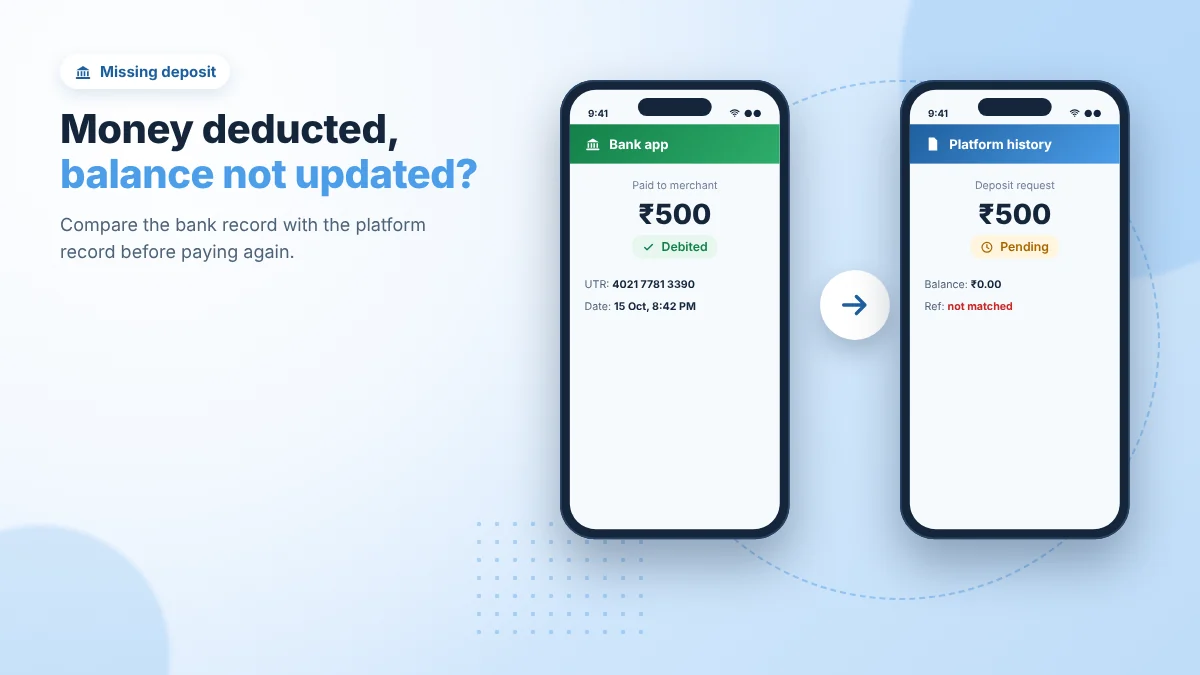
Check the Payment Record
Open the transaction details in your bank or payment app. Note the status, amount, recipient, date and reference number.
Check the account statement as well as any notification. A debit message alone may not explain whether the transaction later failed or reversed.
Compare the Platform Record
Look for the matching deposit entry in your account history. Check the amount and time, and confirm that you are viewing the account used for the payment.
If no entry appears, record that fact. Do not create a second deposit request or enter an unrelated transaction reference to force a match.
Raise the Issue With Evidence
Ask the verified operator support channel to check whether the payment was received and why the account was not credited. Provide the relevant reference and receipt privately.
For a banking or payment-system issue, use your payment provider’s transaction-help or complaint process. Keep the complaint reference and any written response. Neither the operator nor this guide can promise a particular outcome.
Deposit Failed: Should You Try Again?
First establish whether the original attempt deducted money. If the status remains pending or the records disagree, resolve that uncertainty before another attempt.
If no money was deducted, read the stated reason for failure. A bank restriction, incorrect detail or unavailable payment route needs its own explanation.
Do not split payments, change accounts or use another person’s details to get around a restriction. A failed payment is a reason to investigate, not an instruction to keep trying different routes.
Paid the Wrong Recipient?
Preserve the transaction details and contact your bank or payment provider promptly. Explain the mistake accurately and ask what reporting or recovery process is available.
Also notify the verified operator if the recipient came from instructions displayed in your account. Keep a copy of those instructions and the relevant support conversation.
Recovery is not guaranteed. Do not pay someone claiming they can reverse the transfer for an advance fee.
Deposit Bonuses and Account Balances
A deposit bonus may be separate from your own funds. If an offer is shown, check its eligibility rules, expiry and any wagering or withdrawal restrictions.
A larger displayed balance does not necessarily mean a larger withdrawable balance. Read how the operator distinguishes deposits, promotional credit and funds eligible for withdrawal.
This guide does not confirm any active deposit bonus or reward amount. Do not send money solely because a message promises an automatic profit.
Details to Keep for a Deposit Complaint
Collect the records that explain the transaction:
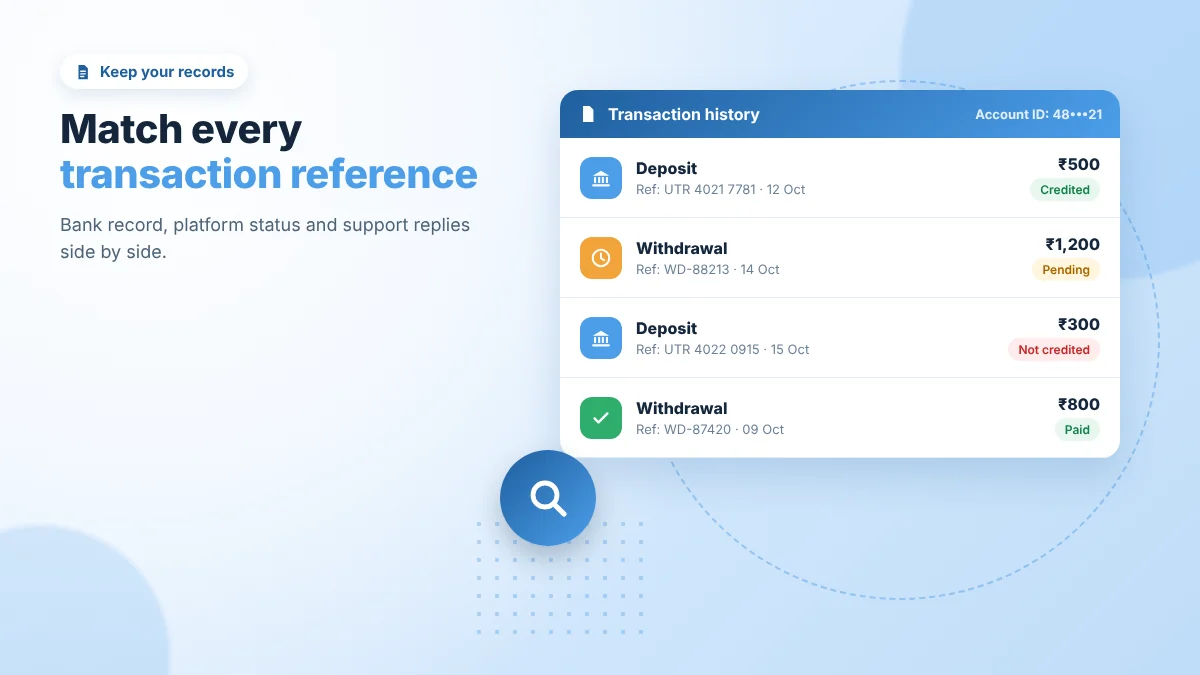
- Account ID and the exact website address.
- Payment amount, date and time.
- Recipient details and transaction reference.
- Payment-provider status and the platform’s deposit status.
- Relevant receipt or statement entry.
- Support case references and replies.
Keep original records privately. Redact unrelated transactions, full account numbers and other sensitive details from copies shared for troubleshooting.
Never include passwords, OTPs, UPI PINs or card security codes.
Payment Warning Signs
Stop and investigate if someone asks you to:
- Make a second deposit to release the first one.
- Pay an “unlock fee” for a withdrawal.
- Send money to a personal recipient without a documented explanation.
- Share a PIN, OTP or account password.
- Install remote-access software for a refund.
- Transfer more because an earlier payment supposedly failed, without checking its record.
An additional payment does not prove that an earlier transaction will be resolved.
Frequently Asked Questions
How do I check a Jio Lottery deposit?
Compare your payment-provider record with the deposit history in the correct account. Match the amount, recipient, time and transaction reference.
Does Jio Lottery accept UPI?
No current UPI availability has been verified here. Do not assume that a payment logo or another website’s instructions apply to your account.
What is the minimum deposit?
A verified minimum amount is not confirmed by this guide. Check the particular operator’s current terms rather than relying on figures from unrelated pages.
How long does a deposit take?
No processing time is confirmed here. Check the actual transaction status and the operator’s documented guidance. Keep evidence if the stated process is not followed.
What if my money was deducted but the balance did not update?
Do not send another payment. Save the reference, compare both transaction records and raise the issue through verified operator support and your payment provider as appropriate.
Should I pay again to unlock a missing deposit?
Do not make an additional payment based on that claim. Investigate the original transaction and the identity of the person requesting more money.
Can a deposit bonus be withdrawn immediately?
That depends on the offer’s documented terms. Promotional credit may have restrictions. No immediately withdrawable bonus is confirmed here.
Does a successful deposit prove the platform is reliable?
No. Receiving a payment does not establish licensing, legal permission, account security or withdrawal reliability.
Check the Original Payment First
For a missing Jio Lottery deposit, the useful starting point is the transaction record. Establish where the money went, what status the payment provider shows and whether the correct account received a matching credit.
Keep your evidence and avoid additional transfers while the original payment remains unexplained.